Thursday, October 17, 2013

The Curveball

Photo by Sean Winters
I've been watching a lot of baseball on TV lately. I think it's amazing how professional pitchers can cause the path of their pitches to curve (or deviate from a straight-line path) radically. Here are some questions for discussion:

  1. Many baseball terms exist to described pitches that curve. For example, curveball, screwball, slider, and cutter. What are the distinguishing characteristics of these pitches? Are there other terms that belong on this list?
  2. What causes a pitch to curve (or break)?
  3. Does the shape of a baseball affect how much it breaks? If so, what shape ball would break the most?
  4. Does the speed of the ball affect how much it breaks?
  5. Thinking about 3 and 4, what kind of ball could you use to demonstrate various breaking pitches? Ideally, the ball would be easy to throw and it would very noticeably break.

Wednesday, October 2, 2013

Thinking about Free Fall


We've been talking about free fall in physics class. Consider the following questions:
  1. What are some examples of object that are in free fall (or at least "nearly" in free fall)?
  2. Can an object be in free fall and have a velocity of zero? Explain.
  3. Suppose the acceleration of gravity on Planet X is 20 m/s/s. How long would it take an object to fall to the ground from a height of 100 meters on Planet X? (Don't just give a numeric answer. Explain your reasoning.)
  4. The acceleration of gravity on the Moon is about 1/6 as much as Earth's. Suppose an astronaut throws a ball up vertically with an initial velocity of 20 m/s. How high above the Moon's surface will the ball rise?  (Don't just give a numeric answer. Explain your reasoning.)
Select one of the above questions and leave your answer as a comment. You can also comment about what another student has said. Please don't continue to comment on a discussion that has been "solved".


Sunday, September 22, 2013

Analog Inputs


Discussion:

We've investigated using the Arduino to read in a digital value. In this case, digital means that a quantity can only have one of two values, namely HIGH (synonymous with "1" or +5 V) or LOW (synonymous with "0" or ground).

Click through the break to begin this activity.

Tuesday, September 17, 2013

A Better Button


Components needed for this lab:

  • push-button momentary switch
  • (1) 1-k resistor
  • (1) 10-k resistor
  • several hook-up wires
Discussion:
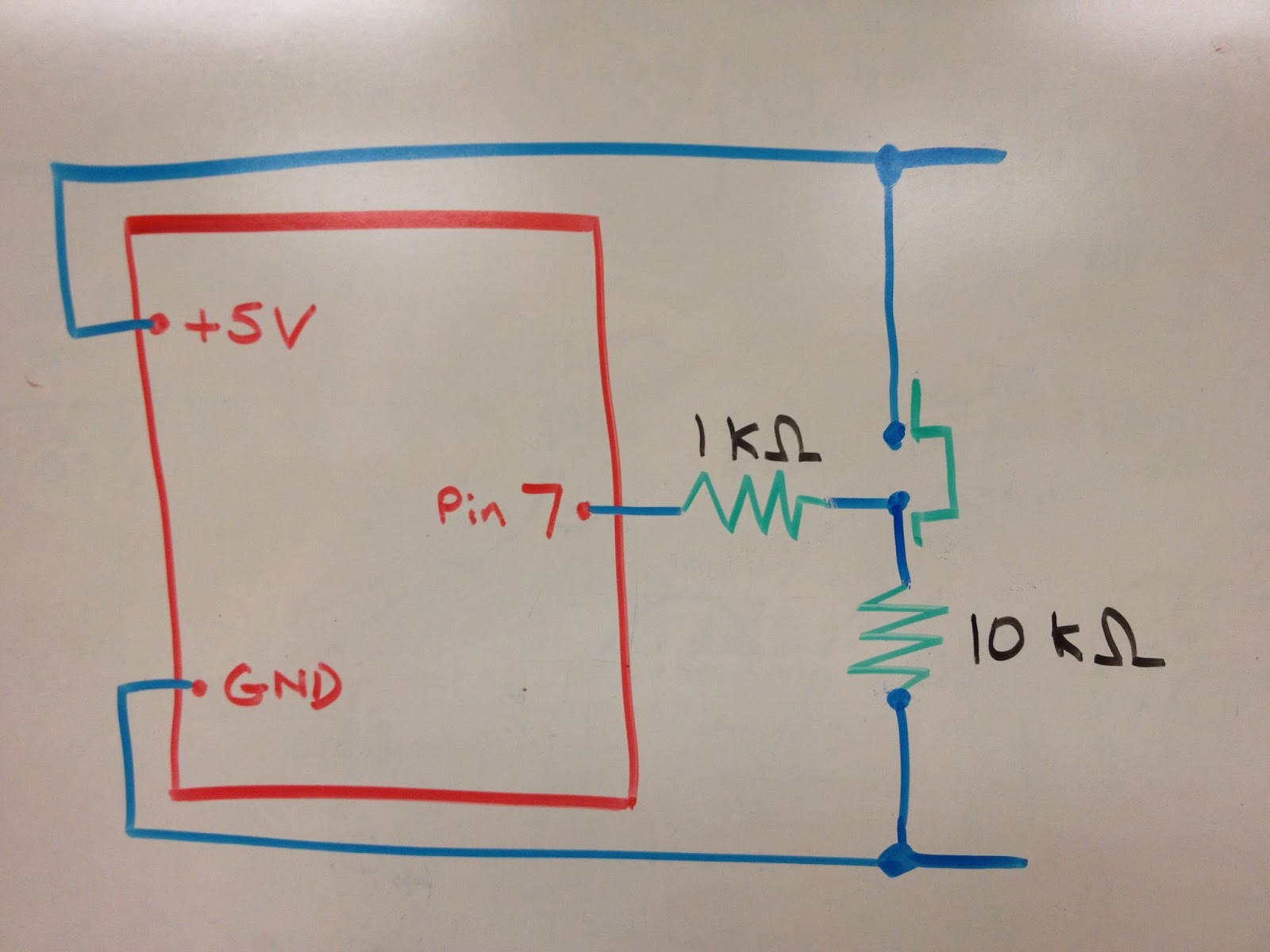
  • Use the diagram above to build the circuit with the button
  • In this case, the 10-k resistor is called a "pull-down" resistor because it normally "pulls" pin 7 to ground. The default "reading" of pin 7 will be LOW since it is connected to ground.
  • When the button is depressed, pin 7 is also connected to +5 volts. Since the button itself offers almost zero resistance, pin 7 is "closer" to 5 V than ground, and so it will read "HIGH". 
  • Notice that when the button is depressed, the +5-volt rail is connected to the ground rail and current will flow between the two. That's why it is imperative to use a fairly large (in this case, a 10-k) resistor--we don't want too much current flowing in that branch of the circuit, overheating the button, and possibly burning out the pins of our Arduino!
Click through the break for more instructions... ...

Thursday, September 12, 2013

Arduino Link

CC image licence BY-NC-SA 3.0